Obsession Review: The Terrifying Cost of Manufactured Love
 ·
Jun 6, 2026
·Updated: Aug 21, 2026 ·
6 min read
·
Jun 6, 2026
·Updated: Aug 21, 2026 ·
6 min readObsession arrives dressed in the familiar costume of a quirky romantic fable, complete with a magical novelty item and a stammering protagonist who believes love can be summoned like a vending machine snack.
Beneath that approachable surface, the filmmakers have constructed something far more disturbing and methodical: a claustrophobic nightmare about the violence of forced affection and the loneliness that drives people to steal connection rather than cultivate it.
Bear, a shy employee at a music store, discovers a trinket called the One Wish Willow that grants his desire to make Nikki, his crush, fall hopelessly in love with him.
The device functions as a stripped-down monkey’s paw, stripping away romantic gloss to expose the raw horror of connection built on coercion rather than mutual choice.
What begins as an awkward, almost comic scenario rapidly inverts into something genuinely frightening, a tonal bait-and-switch that redefines the stakes without ever changing the setting.
Direction here refuses to let the audience laugh for long, pivoting from secondhand embarrassment into a suffocating dread that mirrors Bear’s own panic as his fantasy curdles into imprisonment.
This is not a film about a monster attacking from the shadows; it concerns the horror of being watched, wanted, and consumed by someone who cannot stop, a violation disguised as a gift.
The One Wish Willow Trap

Screenplay treats the supernatural mechanism with an almost casual minimalism that heightens its menace, refusing to over-explain the Willow’s origins or rules so the horror stays grounded in emotional reality rather than mythology.
The narrative restraint forces attention onto the human equation: what happens when a person you desired becomes a person you cannot escape, not because of external threat, but because of your own cowardice.
By treating the wish as a done deal rather than an ongoing puzzle, the story locks us inside the consequences instead of distracting us with lore.
That cowardice becomes the engine of the film’s most agonizing, morally revealing moments of paralysis.
Navarrette’s Unsettling Transformation
Inde Navarrette delivers a performance that anchors the film’s descent into madness without ever slipping into camp or caricature.
Her portrayal of Nikki suggests a consciousness trapped beneath the spell, flickering between genuine tenderness and something mechanical, as if her affection were being puppeteered by an invisible hand that occasionally lets her true self scream from behind glass.
The result is deeply unnerving because she never becomes a simple villain; she remains a victim whose autonomy has been stolen, then weaponized against the thief, creating a tragedy where the monster and the prey occupy the same body.
Navarrette’s physicality carries enormous weight here, communicating volumes when the script goes silent. Small gestures—a smile held two seconds too long, a head tilt that seems calibrated by algorithm, a laugh that lands slightly off-rhythm—suggest a body fighting its own programming.
The performance creates discomfort not through jump scares, but through the creeping realization that Nikki’s love is both absolutely real and absolutely false, a contradiction that haunts every scene she occupies and makes every affectionate touch feel like a threat.
Suffocating in Plain Sight
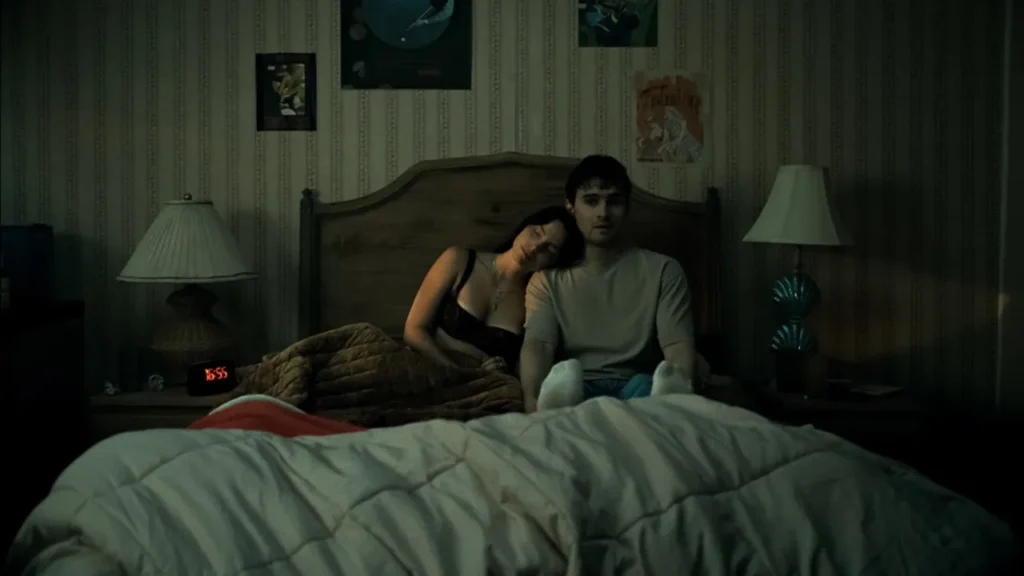
Technical execution mirrors the emotional entrapment with tight, claustrophobic visuals that turn ordinary apartments and music shops into cages. The camera stays close to faces, refusing the relief of wide shots or open spaces, so the audience shares Bear’s sensation of walls closing in without anywhere to rest the eye.
Color palettes lean toward sickly fluorescents and shadowed corners, suggesting a world that has grown smaller and more hostile since the wish was made, while the shallow focus keeps backgrounds blurred and oppressive.
This oppressive intimacy is deliberate and effective, though the relentless narrowness occasionally tips from atmospheric into genuinely unpleasant viewing, trading dread for something closer to cinematic suffocation.
Low budget becomes an asset rather than a limitation, lending the world a grubby, immediate texture that big-studio horror often sterilizes with overproduction.
Johnston’s Cowardice and Our Complicity
Michael Johnston plays Bear as a sympathetic figure who slowly reveals himself as something smaller and more selfish than his initial loneliness suggests. He is not a mastermind but a coward, too weak to undo his wish even as Nikki’s devotion transforms from flattering to terrifying, from endearing to claustrophobic.
Johnston captures the specific shame of someone who has committed a crime against intimacy and lacks the moral courage to confess it, making Bear’s suffering feel earned even as it invites pity, a balance that keeps the character human rather than purely monstrous.
His performance raises an uncomfortable question about audience allegiance that lingers well past the credits.
We enter ready to root for the lonely underdog, yet the film systematically erodes that sympathy by showing how quickly desire becomes entitlement, and how manufactured love is not love at all but a form of possession that eventually possesses the possessor.
The Ridiculous and the Real
Supernatural premise will test the patience of viewers who cannot accept the One Wish Willow as a credible catalyst for such serious emotional destruction.
The device is deliberately absurd—a novelty-store shortcut to cosmic horror—and some narrative beats feel contrived to keep the mechanism in play rather than letting characters behave with basic logic or self-preservation.
Once the wish is granted, the story sometimes strains to justify why Bear cannot simply destroy the object or flee, leaning too heavily on his passivity to maintain the plot’s pressure when a more decisive protagonist would end the film in twenty minutes.
Tonal whiplash between awkward comedy and terror also proves uneven in spots, particularly during the first act. A few early scenes play so broadly that the subsequent darkness feels slightly unearned, as if the film is still finding its footing while asking the audience to already feel dread.
The oppressive atmosphere, while technically accomplished, may alienate viewers who find the emotional suffocation less gripping than simply exhausting, leaving them numb rather than frightened by the final reel.
These flaws do not diminish the film’s achievement as a modern morality fable about honesty and manipulation. Obsession understands that the most frightening monsters are not external threats but the consequences of our own dishonesty, suggesting that true terror begins when we get exactly what we wanted, and discover we are too small to hold it without breaking ourselves or the person we claimed to desire.