Coyote vs. Acme Review: The Looney Tunes Comeback We Almost Lost
Warner Bros. released Coyote vs. Acme, an animated film based on a New Yorker article, after shelving it for a tax write-off.
 ·
Aug 13, 2026
·
4 min read
·
Aug 13, 2026
·
4 min readFew theatrical releases arrive carrying the weight of their own survival story. Coyote vs.
Acme — the hybrid film Warner Bros. once shelved for a tax write-off before public backlash forced a reversal — lands on screen as something rarer than a simple comedy: a piece of animated history clawing its way back from corporate oblivion.
A Premise Stolen from the Roadrunner’s Best Gags
Based on Ian Frazier’s satirical 1990 New Yorker article, the film imagines Wile E. Coyote fed up with decades of Acme products failing him in spectacular fashion. He hires a struggling personal injury attorney, Kevin Avery, to sue the corporation in open court.
What follows is a legal comedy dressed in Road Runner feathers, one that transforms a hundred-year-old gag about faulty anvils into genuine commentary on corporate overreach.
Why Forte’s Sad-Sack Lawyer Holds It Together
Will Forte plays Kevin with the hangdog charisma of a man who has accepted mediocrity as his natural habitat. His every exasperated sigh lands because Forte understands that Kevin’s journey from defeated ambulance-chaser to accidental champion requires the actor to stay smaller than the chaos around him.
When John Cena’s opposing counsel swaggers into frame — all slicked hair and theatrical villainy — the straight-man dynamic clicks into place like a perfectly timed cartoon snare. Cena commits to the bit with such unchecked glee that his courtroom tantrums become the film’s loudest, funniest set pieces.
Eric Bauza Carries the Cartoon Torch
Behind the animation, Eric Bauza voices multiple classic Looney Tunes characters, channeling decades of vocal tradition into work that feels reverent without being archival.
His Daffy Duck carries the manic insecurity that defined the character’s golden era, while his Bugs Bunny updates the rabbit’s smirk for an audience raised on ironic detachment. Lana Condor anchors the human supporting cast with warmth, though her character often disappears during the film’s busiest sequences.
Hybrid Horizons: Roger Rabbit’s Shadow
Director Dave Green stages the live-action/animation blend with obvious affection for Who Framed Roger Rabbit, the obvious benchmark every hybrid film must reckon with. The 2D characters move through practical sets with convincing weight, and production design integrates cartoon logic into human environments without breaking the illusion.
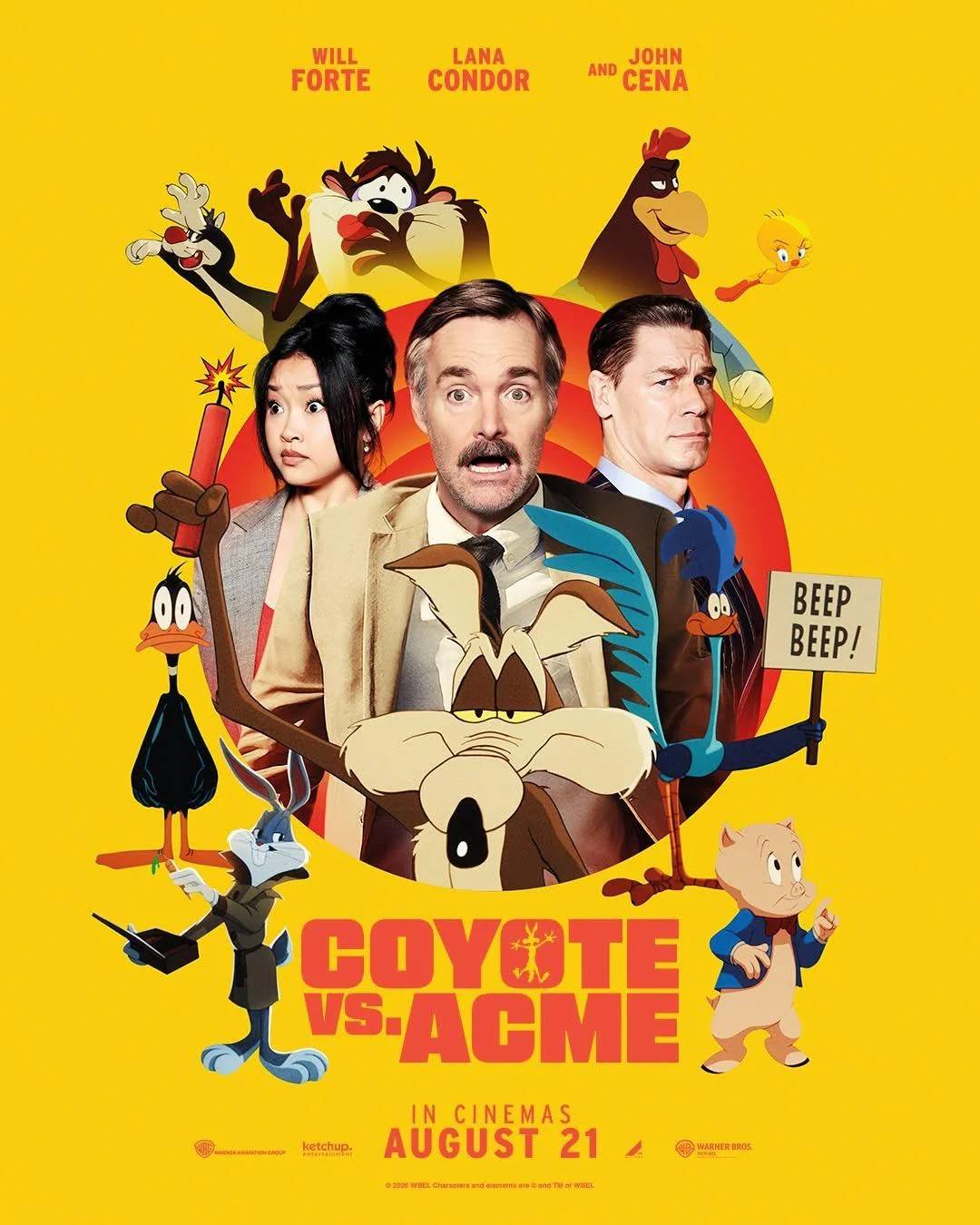
Still, the comparison proves slightly unflattering. Where Roger Rabbit used its hybrid nature to create genuine wonder, Coyote vs. Acme occasionally feels like two films sharing a frame — the animation sequences soar while certain live-action moments sag under the weight of broad sitcom blocking.
Where the Anarchy Goes Missing
The film’s biggest philosophical tension sits in its refusal to embrace the anarchic violence that defined Chuck Jones’s original shorts. Wile E. Coyote never gets flattened by a boulder, never plummets into a canyon, never suffers the beautifully cruel physics that made the character immortal.
This tameness may make the picture more palatable for modern family audiences, yet something essential drains away.
The film gestures toward cartoon mayhem through dialogue and reaction shots, but the commitment to keeping its protagonist physically safe undermines the very premise — a character defined by spectacular failure cannot become heroic without those failures actually occurring.
Structural Hiccups in a Crowd-Pleasing Package
Narrative pacing stumbles in the second act, where courtroom mechanics bog down the forward momentum. The script by Samy Burch spends too long establishing legal procedure before returning to the character-driven comedy that gives the film its heartbeat.
A few gags land with the precision of a well-timed banana peel, but others telegraph themselves from across the theater. The tonal calibration also wobbles when the film attempts genuine emotional weight — moments of sincerity feel grafted onto a story that thrives on absurdist distance.
A Meta-Narrative About Surviving the Shelving
Watching Coyote vs. Acme in 2025, one cannot separate the film from its real-world resurrection. Warner Bros. treated a completed, presumably entertaining movie as a financial instrument — something to be written off rather than released.
The picture’s existence on screen becomes an accidental act of defiance against that logic, a reminder that art and accounting operate on different moral planes. Every laugh feels like proof that audiences, not balance sheets, should determine what reaches theaters.
The Verdict: A Worthy Resurrection
For all its imperfections, Coyote vs. Acme delivers something increasingly precious: a big-screen animated property that respects its source material without embalming it. The Easter eggs reward longtime fans, the voice work honors vocal traditions stretching back decades, and Forte’s weary hero earns the film’s emotional crescendos. The picture stumbles when it forgets that the best Looney Tunes stories trusted their audience to handle sharp edges. What remains is a rousing, frequently hilarious hybrid that earned its second chance — and proves that some cartoons, like some coyotes, refuse to stay down.