The Last House Review: A Sealed Home, An Unfulfilled Promise
A Seattle family's home is sealed by an invisible force, trapping them inside with no explanation.
 ·
Aug 8, 2026
·Updated: Aug 10, 2026 ·
6 min read
·
Aug 8, 2026
·Updated: Aug 10, 2026 ·
6 min readThe Last House arrives on Netflix carrying a premise so immediately arresting that you can almost forgive the disappointment of its execution. A middle-class Seattle family wakes to discover their home sealed by an invisible force, trapping them with no explanation and no exit.
It’s a concept tailor-made for sustained anxiety, and for roughly its first act, the film delivers. After that, the walls close in not from the outside, but from within the screenplay itself, as a promising chamber piece slowly surrenders to its own unwieldy ambitions.
The setup needs little elaboration. Jason and Ann are a couple with two children and a comfortable Craftsman home, the kind of domestic space that feels both aspirational and recognizable. One morning, the doors won’t open. The windows won’t budge. Phones still work, barely, but WiFi cuts out within hours.
What follows is part disaster film, part family drama, part eco-parable, with the screenplay attempting to juggle all three without fully committing to any.
Director Louis Leterrier builds a moody, rain-slicked Seattle that practically hums with dread, and his camera lingers lovingly on the textured walls and cluttered shelves of the family home. For a while, the atmosphere alone carries you.
Moura and Lee Anchor the Ordinary in the Extraordinary
Wagner Moura brings a weary, grounded authority to Jason that elevates every scene he occupies. His Jason is a former firefighter, and Moura plays him with the specific physicality of someone who has learned to stay calm when the building is on fire, even when the fire is metaphysical.
He listens to his wife, defers to the children, and yet carries a private fury that occasionally surfaces in a clenched jaw or a slammed cabinet.
The film never quite gives him a monologue equal to his performance, but Moura fills in the silences with such specificity that you almost forget how thinly the character is drawn.
Greta Lee matches him beat for beat as Ann, the family’s emotional cartographer, mapping the shifting moods of her husband and children with an attentiveness that feels almost surgical.
Lee has spent the last several years establishing herself as one of the most precise actors working, and The Last House benefits enormously from her ability to convey an entire inner life through a glance at a half-packed suitcase or a phone held to a silent receiver.
The Pandemic Echoes Are Loud, Sometimes Too Loud
It’s impossible to discuss The Last House without addressing the elephant trapped in the room: the pandemic. The film wears its lockdown parallels on its sleeve, sometimes subtly, sometimes with all the grace of a cinder block.
The family unit under siege, the fractured communications, the gradual discovery that neighbors are dealing with their own invisible emergencies, all of it maps onto collective experience with uncomfortable precision.
Early scenes of a community Slack channel, neighbors sharing resources and theories across a digital void, land with real specificity.
There’s even a pointed irony in watching a Netflix original that champions physical media because streaming has become useless, the kind of meta-textual wink that suggests a sharper film lurking beneath the surface.
Where the screenplay overreaches is in its attempt to graft on additional anxieties. Climate change gets name-checked through a phenomenon called “chubby rain,” heavier, denser precipitation that the government dismisses as a hoax.
Critics have rightly compared this concept to the fictional thriller from the 1999 comedy Bowfinger, and the comparison is not flattering.
Production Design Saves, CGI Punishes
The physical production is among the film’s most reliable assets. The Craftsman home feels like a real place someone has lived in for fifteen years, with a mudroom of abandoned shoes, a fridge cluttered with school art, and a basement workshop that becomes increasingly central to the plot.
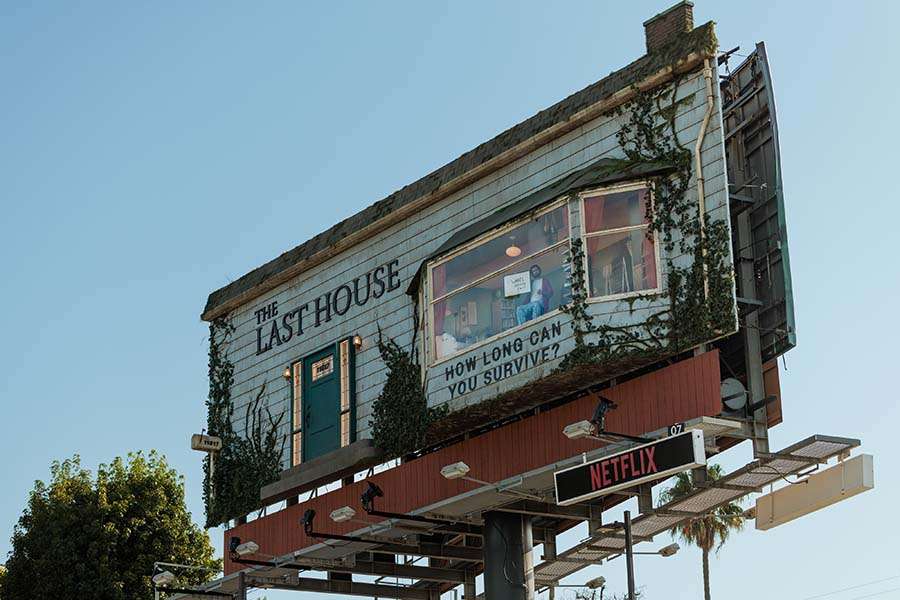
Cinematographer Marcell Rév finds claustrophobic angles in tight hallways and uses the home’s vertical space cleverly, tracking characters from the attic down to the crawlspace as the walls seem to compress. The digital work, unfortunately, is another story.
Any exterior shot that requires environmental extension, including skies, distant cityscapes, and a sequence involving the family car, is rendered with effects so unconvincing they pull the eye out of the frame.
One early helicopter shot of Seattle is so obviously composited it looks like a screen saver. For a film about the fragility of the spaces we inhabit, the cheapness of those visual seams becomes thematically embarrassing.
The sound design fares better, using the creak of old wood and the hush of unnatural rain to build a cocoon of tension that the script eventually fails to sustain.
The Third Act Eats Itself
Around the midpoint, The Last House develops a curious case of narrative anemia. The first act crackles with discovery; the second act settles into a domestic rhythm that, while sometimes effective, allows the tension to leak out one window at a time.
By the time the film pivots toward its climax, the screenplay seems unsure of what kind of story it’s been telling. Leterrier’s direction, which earlier deployed restrained, observational camerawork, gives way to generic thriller staging, complete with jump scares that feel imported from a lesser film.
A late-film twist involving a government response arrives with neither the political bite nor the emotional catharsis it demands. Logical inconsistencies compound the fatigue. Characters make decisions that only make sense if the plot needs them to happen in a specific order.
Sealed Inside a Good Idea
The Last House is the kind of streaming-era film that feels destined to surface in algorithmic recommendations six months from now, watched halfway through on a phone, and promptly forgotten. There’s no scandal here, no breakout moment, no scene destined for the meme cycle.

It is competent, sometimes atmospheric, occasionally well-acted, and almost entirely hollow at its center.
Leterrier has made a perfectly serviceable thriller that mistakes the presence of big ideas for their development. Moura and Lee deserve a better house to live in, and so, frankly, do we.