Franchise Shifts Tone in Enola Holmes 3 as Wedding Turns to Thriller
 ·
Jul 1, 2026
·Updated: Aug 21, 2026 ·
4 min read
·
Jul 1, 2026
·Updated: Aug 21, 2026 ·
4 min readThe third Enola Holmes film arrives carrying ambitions it cannot quite support, a coming-of-age story that mirrors its heroine’s own difficult transition into a world of colonial guilt, wartime atrocities, and adult consequence.
Set in 1885, the story begins at what should be a moment of triumph: Enola’s wedding to Lord Tewkesbury.
Within minutes, the ceremony is interrupted by a desperate telegram, and our newly minted bride is barreling toward Malta to rescue her kidnapped brother Sherlock from a trap tied to a decades-old murder.
Jack Thorne’s screenplay, working from Nancy Springer’s source material, has traded the light-footed detective games of the earlier films for something considerably heavier.
The Girl Detective Grows Up
Millie Bobby Brown remains the franchise’s gravitational center, and the film knows it.
Her Enola has always worked because Brown plays the character as if she is perpetually delighted by her own existence, a quality that made the fourth-wall-breaking conceit of the first film feel like genuine invention rather than gimmickry. Here, that effervescence is dampened by design.
The screenplay asks Enola to confront the gap between the woman she imagined becoming and the compromises adulthood actually demands, and Brown navigates that shift with admirable control, letting the brightness flicker when the story requires it without ever extinguishing it entirely.
The fourth-wall asides persist, but they land awkwardly without the narrative velocity to justify their interruption.
Cavill, Bonham Carter, and the Holmes Family Chemistry
Henry Cavill’s Sherlock functions as the film’s gruff emotional anchor, and his dynamic with Brown carries the rare texture of a real sibling relationship.
Their scenes in the Malta sequences trade barbs with the weary affection of two people who have long since exhausted their capacity for pretending they do not care about each other.
Helena Bonham Carter’s Eudoria Holmes remains a fan-favorite element for good reason; her brief appearance reminds viewers what the franchise loses when it moves too far from the domestic warmth of the Holmes family hearth.

Louis Partridge’s Tewkesbury, meanwhile, is asked to do the thankless work of representing everything Enola might be giving up, and he does it with a hangdog sincerity that, in a less cluttered film, might have registered as tragic.
A Convoluted Case in a Beautiful Location
Malta is gorgeous. The production design team has clearly relished the opportunity to dress Mediterranean fortifications and harbor towns in period detail, and several set pieces, including a chase through a festival procession and a tense sequence in an underground crypt, earn their runtime.
The problem is what connects them. The central mystery involves war crimes, concealed identities, and a conspiracy stretching back decades, and Thorne’s plotting struggles to make these mechanics feel organic rather than mechanically assembled.
The flashbacks, deployed to deliver crucial exposition, halt the forward momentum just when the film most needs to accelerate.
Barantini at the Helm
Director Philip Barantini, working from a script by Jack Thorne, brings the same sober craftsmanship that distinguished his earlier work, including the celebrated Boiling Point. The comparison is instructive: Barantini excels at sustained, naturalistic pressure, the slow build toward an emotional detonation.
That sensibility sits uneasily with material that requires the helium-filled energy of a children’s adventure franchise. Where Harry Bradbeer’s earlier installments made Victorian England feel like a playground bursting with secrets, Barantini’s Malta feels like a crime scene awaiting forensic examination.
The competence is evident throughout, but the distinctive flair that made the first two films feel like their own thing is largely absent.
The Weight of the Themes
The film’s engagement with British colonialism, women’s rights, and the tension between marriage and personal autonomy represents the most ambitious thematic territory the franchise has attempted.
There are moments when this material achieves genuine power, particularly in a confrontation between Enola and a figure who represents the seductive pull of conventional respectability.
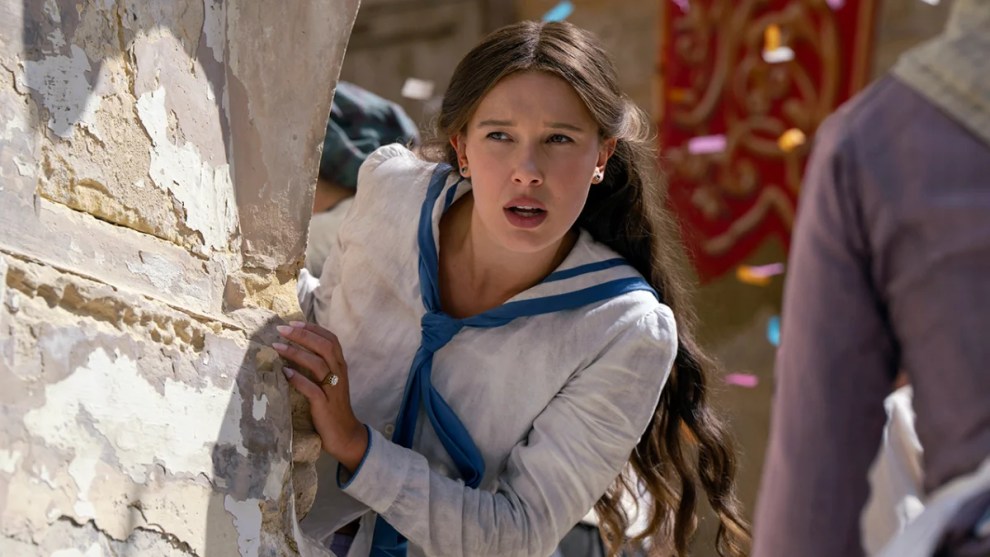
The franchise’s evolution mirrors Enola’s own maturation, which functions as both the film’s central thematic achievement and its primary structural liability. The colonialism commentary is interlaced with detective mechanics rather than allowed to develop its own moral architecture.
Enola Holmes 3 is a film caught between identities: too somber for the exuberant family audience that built the franchise, too convoluted for viewers drawn by its serious intentions. Brown’s performance ensures the enterprise never collapses, and the Malta production values provide genuine visual reward.