Camp Miasma and the Sweet Rot of Inheritance
Jane Schoenbrun’s Teenage Sex and Death at Camp Miasma follows a queer filmmaker reviving a transphobic slasher franchise with its final girl’s reluctant…
 ·
Aug 7, 2026
·Updated: Aug 10, 2026 ·
6 min read
·
Aug 7, 2026
·Updated: Aug 10, 2026 ·
6 min readA young filmmaker accepts a job that should repel her, and the resulting film does something rarer than subverting expectations: it metabolizes them.
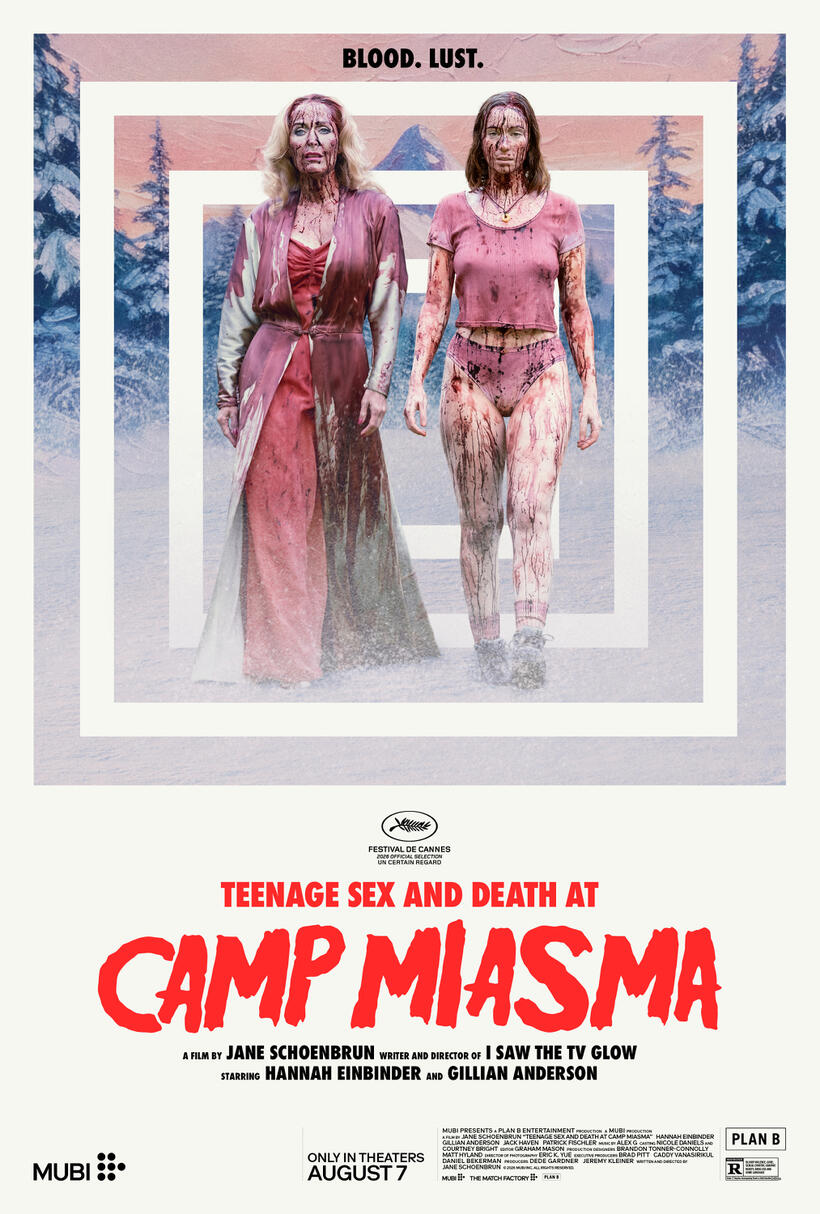
Jane Schoenbrun’s third feature, Teenage Sex and Death at Camp Miasma, follows Kris, a queer filmmaker hired to reboot a fictionalized ‘80s slasher franchise whose original incarnation trafficked in transphobic panic.
Her pitch to revive the property comes with a single condition: she wants Billy Presley, the reclusive final girl from the original film, on board.
What unfolds is less a horror reboot than a two-hander about the violence of inheritance, and what it costs to love the art that failed you.
The Candy Aisle as Crime Scene
The film’s production design drowns every frame in sugar — candy canes, gumdrops, melted ice cream dripping from set walls.
At first it reads as pure aesthetic maximalism, the kind of heightened, nostalgic visual vocabulary Schoenbrun established in We’re All Going to the World’s Fair and refined in I Saw the TV Glow.
But the candy accumulates meaning as the narrative progresses. Production designer elaborately staged fake-blood geysers alongside lollipops, creating a visual grammar where sweetness and violence become indistinguishable.
The pleasure of consuming commercial art and the damage it inflicts share the same wrapper, and no character in the film can fully separate the two.
That the original Camp Miasma franchise is a transparent analog for Friday the 13th and Sleepaway Camp gives the premise immediate purchase. Anyone who came of age on slashers knows the particular embarrassment of canonizing films that were cruel to people like them.
Schoenbrun treats that embarrassment as raw material rather than something to overcome.
Hannah Einbinder’s Reluctant Knife
Einbinder plays Kris with a specificity that keeps the film from collapsing into allegory. Her comedic timing is dry and involuntary, as if jokes escape her before she can approve them.
But underneath the brittle industry-kid patter sits genuine ambivalence about the project she’s been hired to shepherd. Einbinder lets you watch Kris calculate her compromises in real time, and the performance becomes a study in how queer artists learn to perform enthusiasm for systems that exploit them.
Several moments where Kris pitches the reboot to studio executives land with uncomfortable precision — the rhythm of those scenes mimics the cadence of selling out.
Gillian Anderson’s Billy Presley is the film’s gravitational center, and Anderson deploys stillness the way other actors deploy volume. Billy hasn’t done an interview in decades, and Anderson communicates that withdrawal without ever playing it as affectation.
She arrives on screen like a woman who has already survived everything the plot might threaten her with.
The chemistry between Einbinder and Anderson avoids the easy route of mentorship or romance their dynamic reads instead as recognition, two people who share a specific wound and can’t quite decide whether to tend to it together or pick at it.
The Counting Crows Problem
Midway through the film, a pivotal sequence unfolds set to a Counting Crows song, and it’s the moment where Schoenbrun’s stylistic ambitions either crystallize or curdle depending on your tolerance.
The sequence uses the song’s nostalgic ache to reframe everything preceding it, retroactively recasting Kris’s project as a kind of self-harm.
Critics who arrived skeptical of the film’s self-seriousness have described this scene as the point where ambivalence dissolved into belief. Others will find it a touch too on-the-nose, a director winking at her own thesis statement.
The opening credits, set to a haunted cover of R.E.M.’s “Nightswimming,” function more successfully because the song’s melancholy is allowed to operate without commentary. The soundtrack overall walks a tonal tightrope, and the film loses its footing occasionally when the music editorializes what the images already convey.
The Abstract Turn
The final act abandons linear storytelling almost entirely, shifting into surreal visual sequences that function as dream logic rather than plot. This is where the film’s accessibility advantage over Schoenbrun’s prior work begins to fray.
Viewers expecting the genre mechanics the premise promises will feel stranded the slasher reboot becomes a ghost the film occasionally visits rather than inhabits. The structure mirrors its themes, a story about being unable to finish a compromised project becoming a film that refuses to finish itself neatly.
But admiration for the concept doesn’t eliminate the experience of watching a narrative lose its thread in the third act. Character motivations in the late sections also grow opaque. Kris’s professional calculus stops being legible, and Billy’s arc demands an emotional buy-in that the film hasn’t fully earned.
These aren’t fatal flaws, but they create stretches where Camp Miasma feels less like a movie and more like a mood board for one.
Cinephilia as Autopsy
What Schoenbrun understands, and what separates this from standard reboot commentary, is that cinephilia itself is a form of self-injury for people whose formative texts didn’t imagine them as fully human. The film treats horror fandom as archaeology, digging through beloved trash to find what might be salvageable.
Kris functions as a transparent surrogate for her director, and the movie gains enormous power from that transparency.
When Kris defends the Camp Miasma franchise to a journalist, she’s articulating a position anyone who’s logged decades loving problematic art will recognize: the defensiveness, the rationalization, the desperate need to extract meaning from texts that may have never intended to provide it.
The film also grapples with the impossible pressure on trans and queer artists to represent entire communities through their work. Kris’s industry handlers frame her queerness as a marketing asset, and Schoenbrun dramatizes that commodification with quiet fury.
Every studio note scene lands because it follows recognizable rhythms of how identity gets packaged for distribution.
What the Blood Means Now
Somewhere in the middle of Teenage Sex and Death at Camp Miasma, a character suggests that the fake blood in slasher films was always real for someone, even when it wasn’t literally flowing.
The line sounds like a thesis statement, and it is, but the film earns it through accumulation rather than declaration.
Schoenbrun has built a body of work about the screens we grow up staring at and what they take from us, and this is her most generous and accessible entry — a movie that trusts its audience to feel ambivalence without resolving it into a clean moral.